When businesses start looking for design support, the decision often feels like a simple one.
Hire a freelancer. Or hire an agency.
Freelancers are usually seen as flexible and affordable. Agencies are seen as structured but expensive. So companies assume they have to choose between the two. But that assumption oversimplifies how design work actually happens.
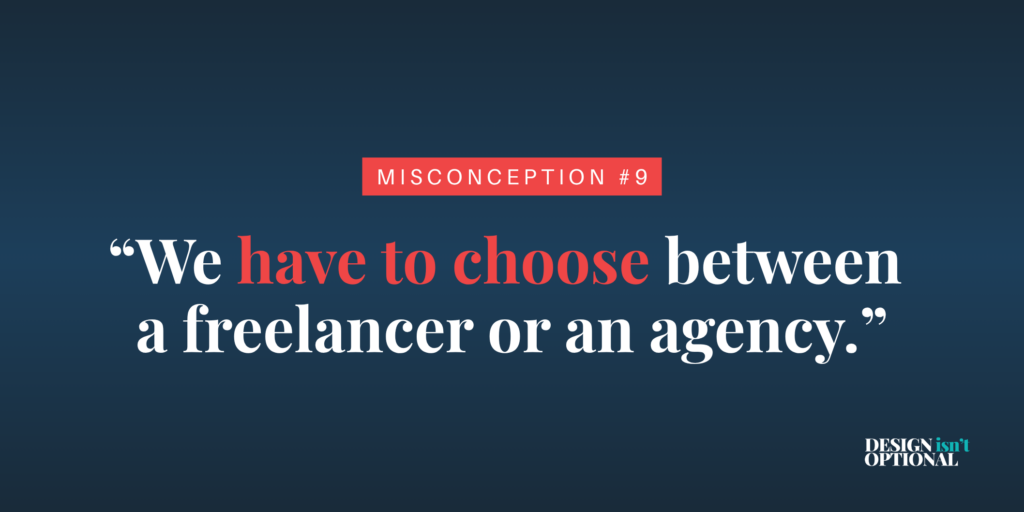
Misconception #9
“We have to choose between a freelancer or an agency.”
This belief assumes that design support only exists at two extremes. One individual working independently. Or a full agency with layers of process, pricing, and overhead.
In reality, those aren’t the only options. And more importantly, the choice of model matters far less than most teams think.
Why This Belief Happens
The design industry has historically been structured around these two models. Freelancers often work independently and are hired for specific tasks. Agencies typically offer full-service teams with larger infrastructure. Because those models are the most visible, businesses assume they represent the entire landscape.
And honestly, both have worked well for a lot of organizations. The freelancer relationship in particular can be incredibly effective, especially for defined, repeatable work with a trusted creative who knows the brand well. The limitation isn’t the model itself. It’s what happens when the work grows beyond what that model was designed to handle.
Most organizations don’t fully fit into either option. They don’t need agency-level overhead, but they also can’t afford to rely on a single point of failure. That’s where the decision starts to feel like a trade-off — when really, the issue is something else entirely.

The Reality
The real question isn’t freelancer vs. agency. It’s structure vs. fragility.
A growing marketing team might work well with a freelancer for one-off projects, but hit a wall when they need several things done simultaneously, or when that person is unavailable during a critical launch window. That’s not a freelancer problem. It’s a structure problem. The work outgrew the setup.
The same can happen with agencies. A team that brings in a large agency for a straightforward project may find the process slower and more costly than expected — not because the agency isn’t capable, but because the structure is more than the work actually requires.
Freelancers can provide speed and flexibility. Agencies provide scale and structure. But many organizations need both — experienced designers, reliable communication, consistent brand oversight, and the ability to handle changing workloads without starting over every time.
That combination doesn’t always require a traditional agency. It requires a creative structure that supports the work.
What Strong Design Environments Do Differently
Organizations that maintain strong design support focus on structure rather than labels. Here’s what that tends to look like in practice.
They reduce single points of failure
Design work continues even if one person becomes unavailable. In practice, this might mean having more than one designer familiar with the brand, or a project manager who keeps things moving when creative capacity shifts. Projects don’t stall or restart — they keep moving forward.
They maintain creative oversight
A clear design direction keeps materials consistent and intentional across every project. Without it, work produced by different people at different times starts to drift — even when the individual pieces look fine on their own.
They build systems, not one-off outputs
A brand guidelines document, a template library, a defined approval process — these are the things that make the next project faster and more consistent than the last one. Design decisions are supported by structure, not recreated from scratch each time.
They scale when needed
Teams can expand or contract depending on workload without losing quality or consistency. A product launch or a busy quarter doesn’t mean starting over. It means the existing system absorbs the additional work.
They support the business, not just the deliverables
Design becomes part of how the team operates, instead of a series of disconnected tasks. Fewer revision cycles. Faster turnaround. More consistent output across every touchpoint.
What to Look For
Whatever model you choose, a few things are worth looking for regardless of the label:
- A single point of contact who owns the relationship and the output
- A process that doesn’t require you to start from scratch each time
- Someone who understands your brand well enough to work with minimal direction
- The ability to scale up when workloads increase without losing consistency
- Clear communication and predictable delivery — so you’re never chasing updates
The Bigger Lesson
The freelancer versus agency decision feels important. But it’s not the real question.
The real question is whether the work is supported in a way that makes it consistent, reliable, and scalable. When structure is missing, design becomes unpredictable — regardless of who is doing it. When the right systems are in place, it becomes dependable.
That has a direct impact on the business. Faster turnaround means campaigns move on schedule. Fewer revision cycles means internal teams spend less time managing creative. Consistent output means the brand builds recognition instead of creating confusion.
This is why design isn’t optional. It’s not just about producing work. It’s about creating a system that allows that work to succeed — every time, not just when everything goes smoothly.
Most teams come into the process thinking they need to choose between a freelancer or an agency. What they’re usually looking for is something more balanced — direct access to experienced designers, combined with the structure needed to keep work consistent and moving forward.
When that combination is in place, design stops feeling like something you manage and starts working the way it should — quietly, reliably, and in support of everything else the business is trying to do.